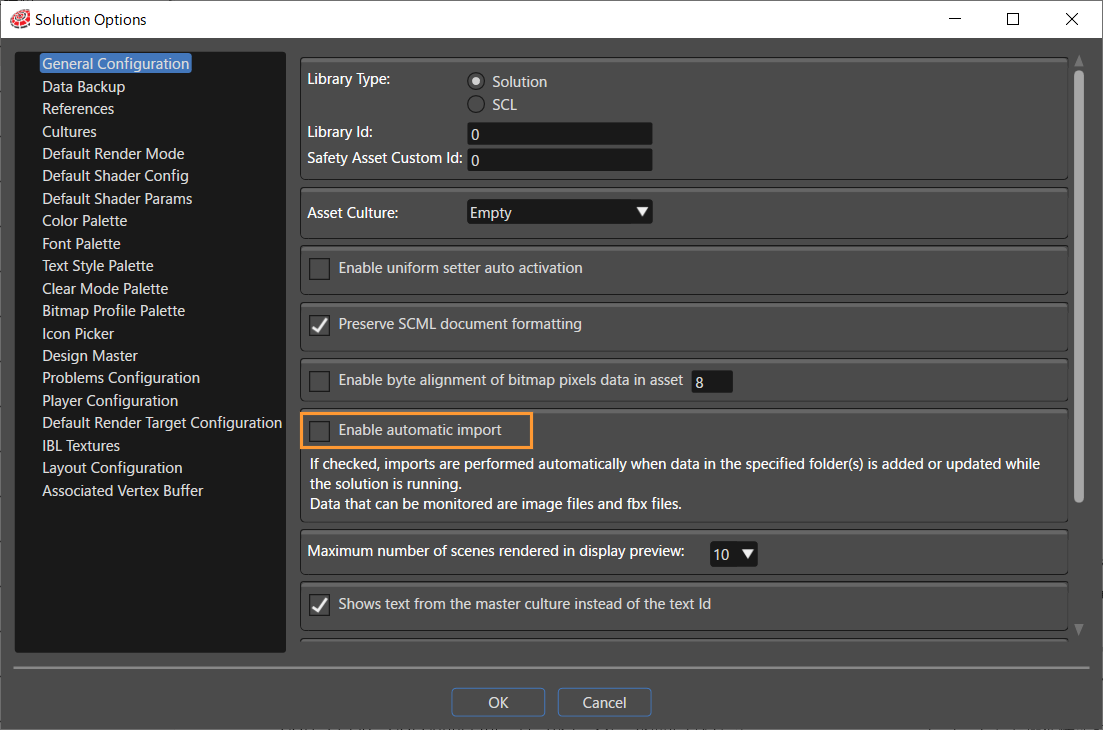
General Configuration
This section allows you to configure fundamental settings that affect the entire solution. It includes essential parameters such as the library type (Solution/SCL), identification settings, default culture, text style, and memory usage options. These configurations directly influence the structure, reusability, and behavior of the project. It is recommended to review and define these settings early in the development process.
Library Management Settings

This group of settings defines the classification and identification properties necessary for managing reusability and uniqueness of a solution. By utilizing the SCL format, you can export a solution as a reusable component and share its resources with other projects.
-
Library Type:
Specifies whether the current solution should function as a standard project (Solution) or as a reusable library (SCL: Shared Component Library). When configured as an SCL, the solution can be exported as an archive containing SCML, binary files, and metadata, and then reused in other projects. -
Library Id:
A 32-bit unsigned integer used to uniquely identify each item in the library within the solution. If the value is set to 0, it will be automatically generated upon saving. -
Safety Asset Custom Id:
This field is used to assign additional identification information related to safety or functional classification. It can be helpful for asset-specific management and control purposes.
Asset Culture

The default culture for the solution can be selected from the [Asset Culture] dropdown menu. This setting affects the entire solution and determines the base language and regional formatting used for localized texts and assets.
Enable uniform setter auto activation

When this option is enabled, ShaderParamSetter configurations are automatically applied. If the "Auto activation scope" property is set to Local, per-asset parameter settings that would normally require manual configuration are handled automatically.
If the scope is set to Global, the system uses shader-defined Auto Uniforms to determine and apply all relevant activation flags at asset generation time.
This feature simplifies the configuration process while ensuring consistent rendering behavior. For further information, refer to the Generic ShaderParamSetter documentation.
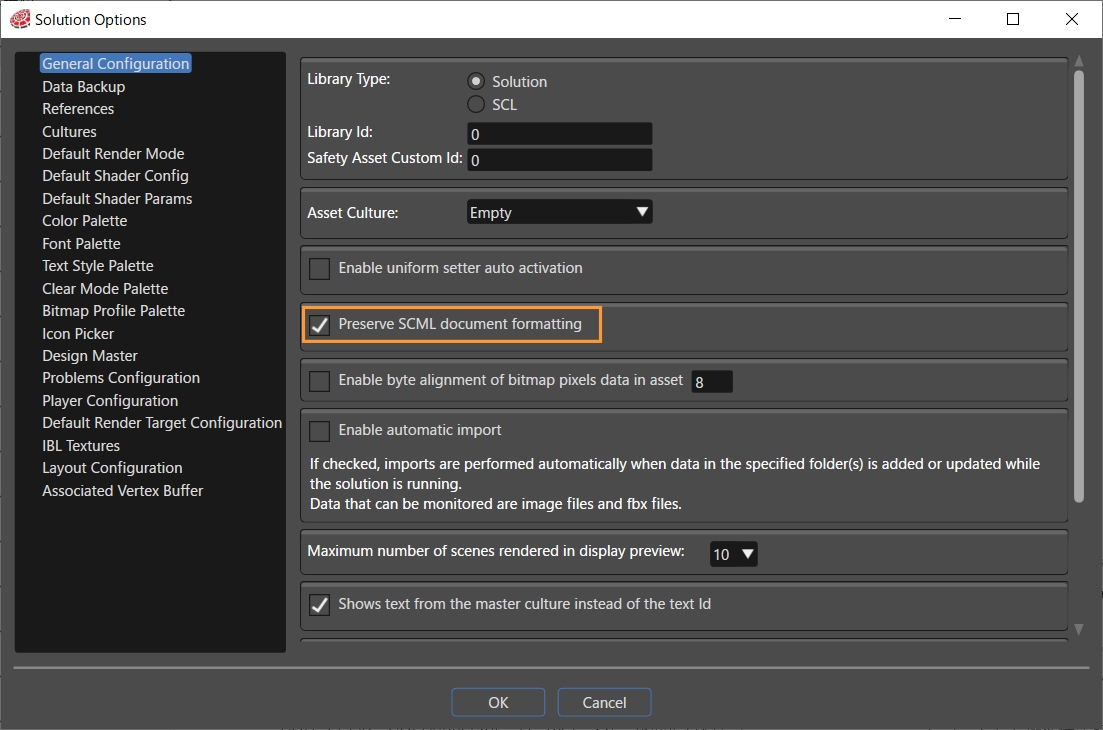
Preserve SCML document formatting

Enabling this option allows the SCML Editor to preserve the original formatting and comments in the SCML source files. This is useful for maintaining manually added annotations or structured formatting. For more information, refer to the SCML Editor documentation.
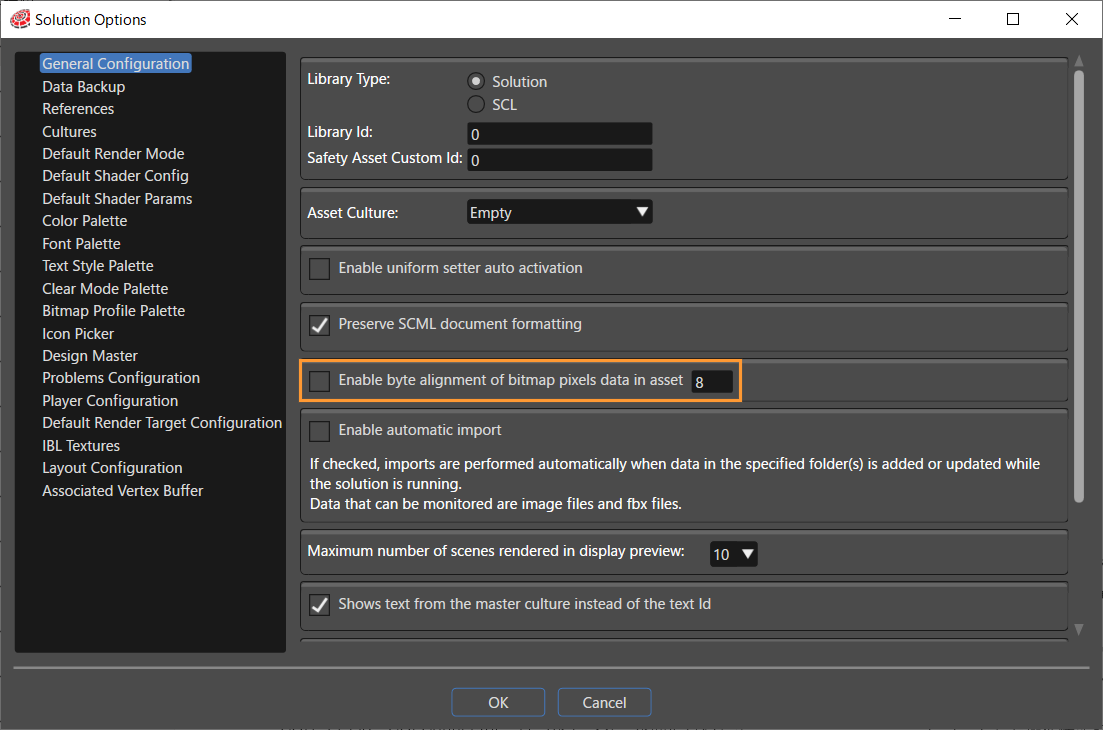
Enable byte alignment of bitmap pixels data in asset

When this option is enabled, Scene Composer aligns bitmap pixel data within asset files to 8-byte boundaries. This alignment can improve graphical processing performance and optimize data transfers in certain environments.
Enable automatic import

To automate the import of image and FBX files, enable this option and configure monitored folders. When new files are added or existing ones updated in the specified folders while the solution is running, the import process is triggered automatically. The monitored folder must be set separately.
Maximum number of scenes rendered in display preview

This setting defines the upper limit of scenes rendered simultaneously in the display preview. It helps prevent excessive resource usage and rendering overhead. Which scenes are rendered depends on the cameras enabled in the Render Targets panel.
We recommend using the dedicated commands in the "Render In Display" menu to enable or disable scenes, cameras, and displays appropriately. If the defined limit is exceeded, a warning is displayed to the user.
Shows text from the master culture instead of the text Id

When enabled, this option displays the actual text from the master culture instead of the text ID. If no text is defined for the master culture, the text ID will be shown as a fallback.
Exports only the master culture

When enabled, only the master culture’s text entries will be included in the exported asset. This is useful when generating lightweight assets prior to localization.
Default text style

The selected text style will be applied as the default for all scene elements in the solution. It defines the initial visual appearance of text objects.
Default memory pool

Selects the memory pool used when loading image data. This setting can affect asset performance and memory usage.
-
VideoMemory:
Stores images in GPU video memory (VRAM). Recommended when high rendering performance is required. -
ClientMemory:
Stores images in CPU system memory (RAM). Useful for maximizing compatibility or when VRAM usage needs to be minimized. -
ExternalMemory:
Uses externally managed memory regions. This is typically used in embedded environments where memory is shared or managed by external systems.
Choose the most appropriate memory pool based on your target system’s architecture and performance requirements.
Library Setting
The main goal of a shareable component library (SCL) solution is to make all the resources from a particular SCS solution available to be used in other solutions. An SCL is an archived file containing SCML/binary files and some meta information. SceneComposer provides the possibility to reuse any part from a solution that is exported as an SCL.
When the user has not decided since the beginning that some parts from the current solution will be reused in a different solution, it is possible to export the solution as a shareable component library (SCL) solution in a different way. For this, the user has to choose the SCL "Library Type" from "File" > "Solution Options" > "General Configuration". The SCL name can be the same with the SCL solution or it can be modified.
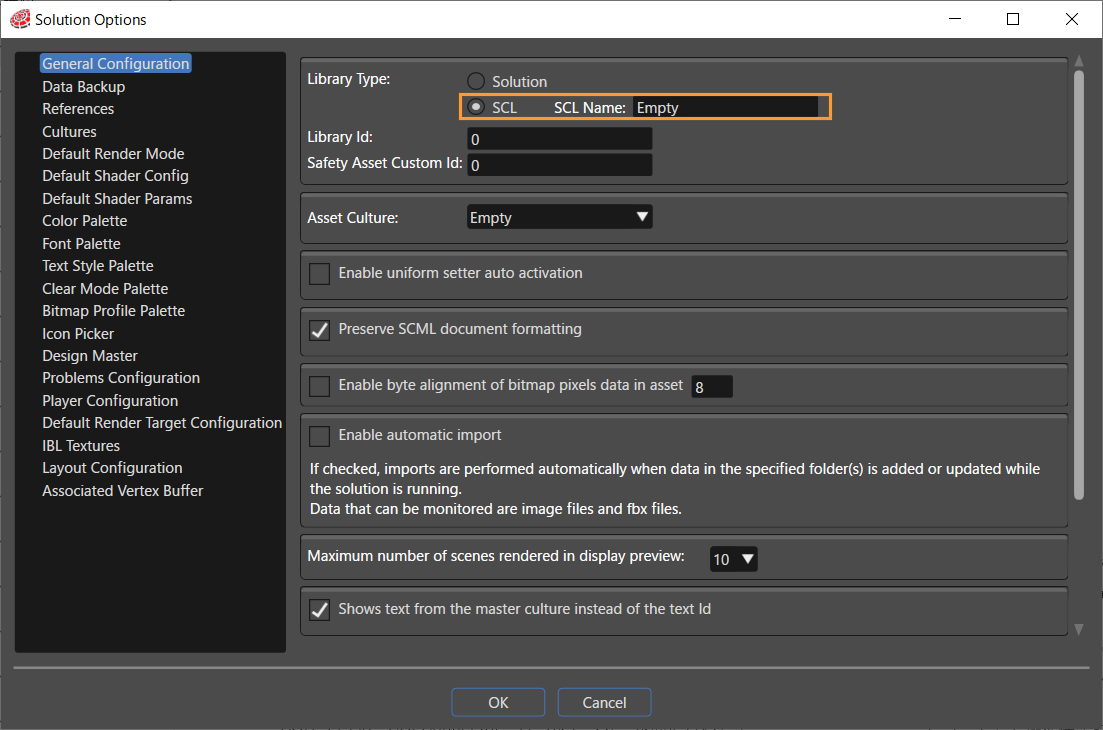
After the solution has been saved, the "Export SCL" option will become available under the "File" menu. In this way, the solution can be exported as a shareable component library (SCL) in any place selected by the user.
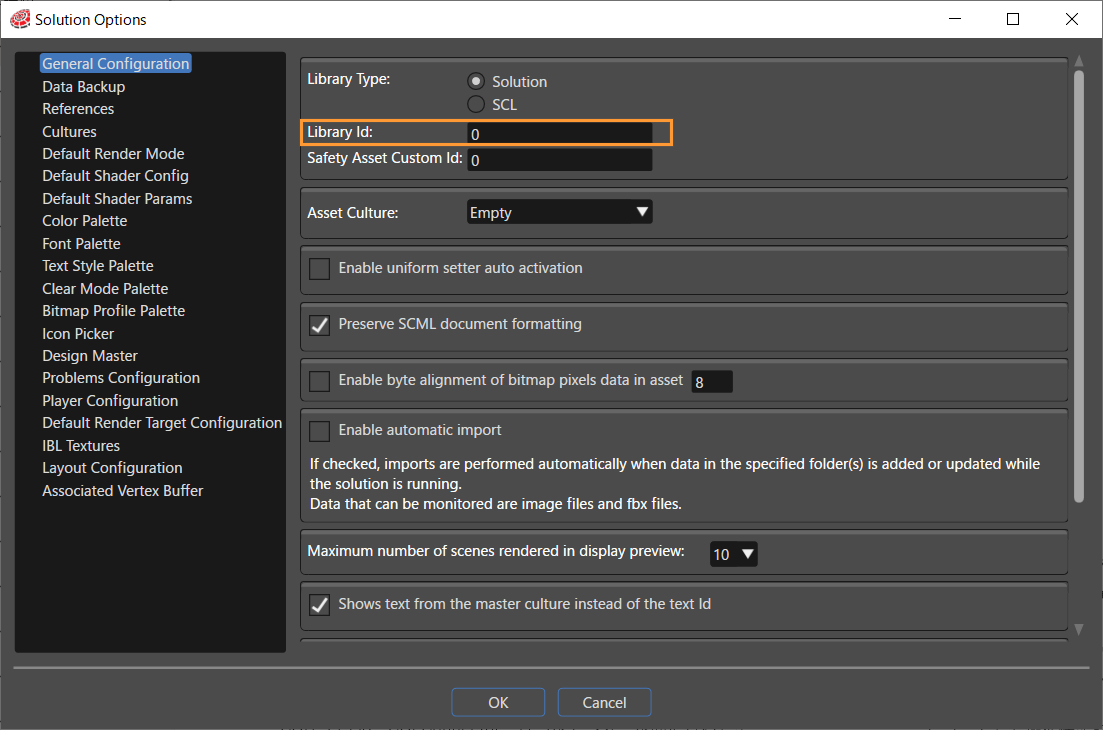
Each library item (library items are items which have a folder as parent) has a LibItemId (32 bit unsigned integer) which uniquely identifies it in the solution. If it is not set (has value 0) an Id will be generated. LibItemId is the Id property displayed in the properties panel for library items ("File" > "Solution Options" > "General Configuration").
Culture Setting
The default culture for a solution can be defined in the General Configuration panel by setting it in the "Asset Culture" drop down list.
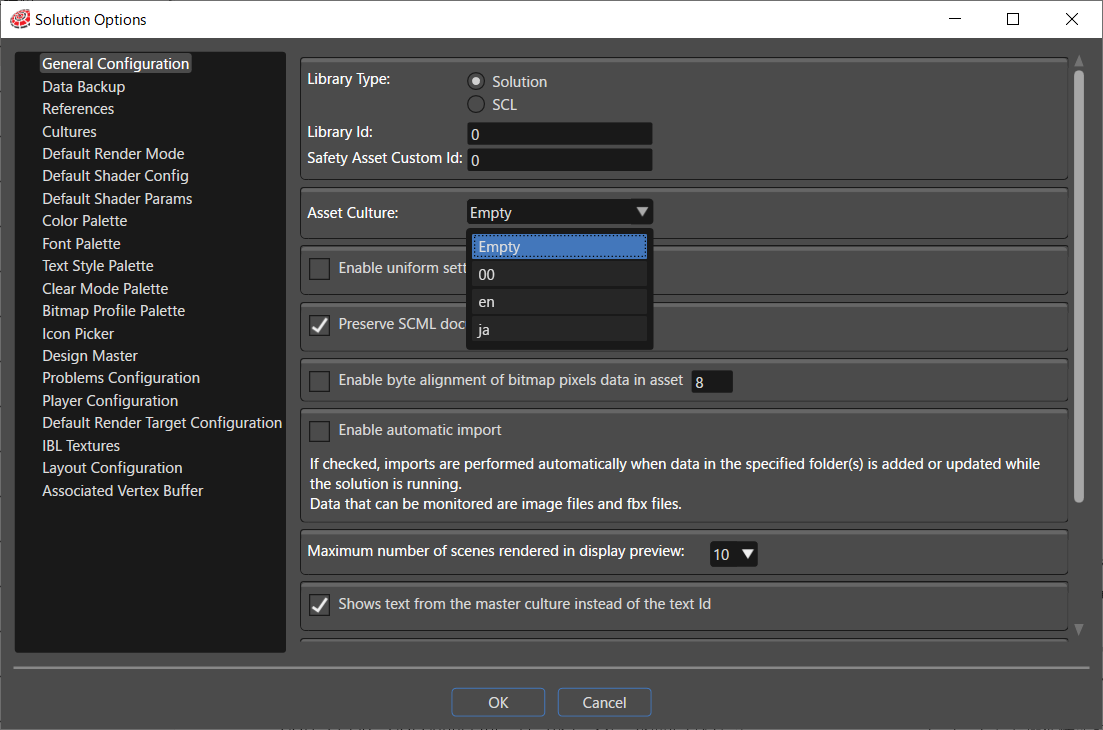
This setting will be available for the whole solution.
Enable Uniform Setter Auto Activation
There is an option to avoid the detailed (i.e. manual) setting of the uniform setters by using the auto activation property. This is possible if the "Enable auto activation" property is enabled and the "Auto activation scope" property is set local.
The "Enable uniform setter auto activation" setting is accessible in the "Solution Options" panel, section "General Configuration".
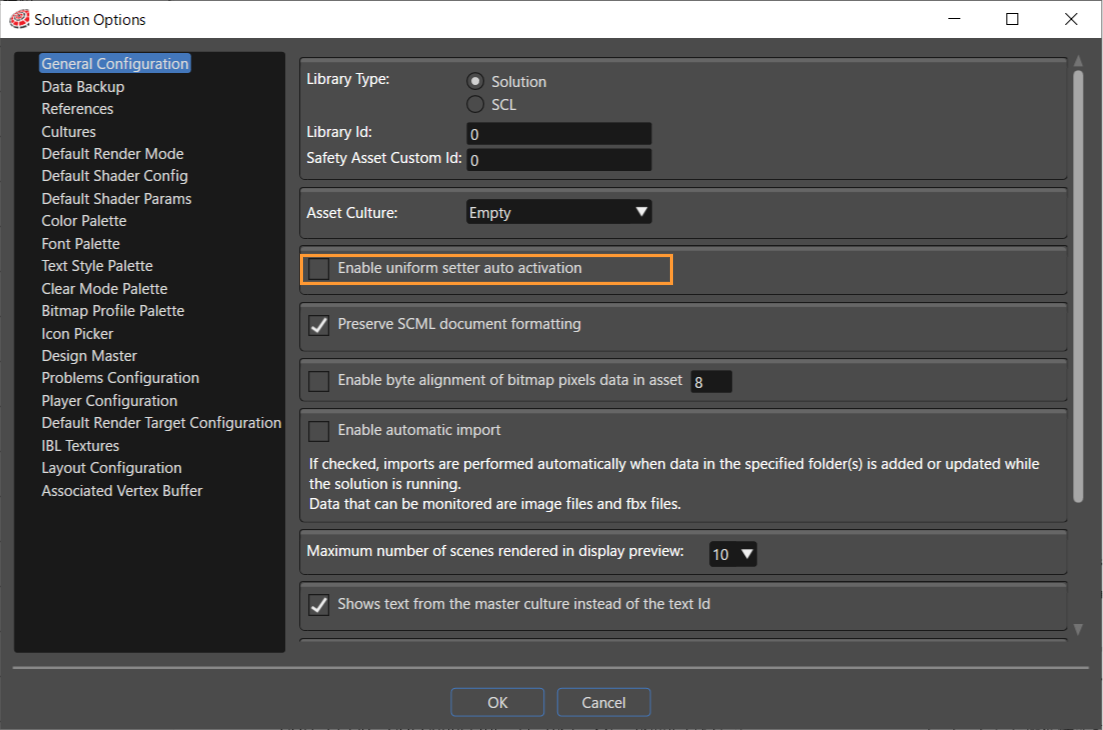
If this global setting is used and the "Auto activation scope" property is set global, the "Enable auto activation" property will become active and all the activation flags will be determined when the asset is generated based on the auto uniforms which are defined in the shader program.
Preserve SCML Document Formatting
When this setting is used, the SCML editor preserves source formatting and comments.
Enable Byte Alignment of Bitmap Pixels Data in Asset
SceneComposer provides a solution option, "Enable byte alignment of bitmap pixels data in asset", to enable and configure bitmap pixel data alignment to a position in the asset file.
If this option is enabled, the bitmap's pixel data will be written within the asset file starting with a position that is a multiple of the given value.
Enable Automatic Import
To configure monitored folders for automatic imports - both images and fbx files - it is mandatory to enable this operation by checking the "Enable automatic import" box.