# Optimize Number of Nodes
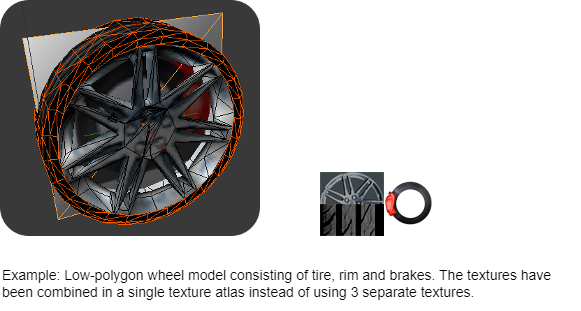
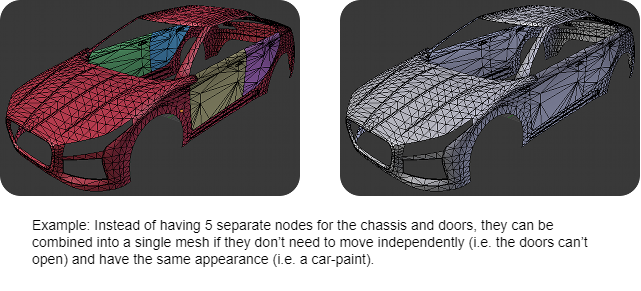
A reduced number of nodes lead to fewer node-related render state activations that have to be processed. Thus, whenever geometry can be safely combined to a single node like e.g. a mesh, then this way should be favoured. For instance a tire and a rim form a logical group sharing the same transformation. In that case the designer can unify separate geometries in a single mesh with the aid of a digital content creation (DCC) tool.
Consequently, the rim and tire do their texture lookup in a single texture, which further leverages performance gains by texture caching.
See below crucial prerequisites for combining Nodes:
- Nodes share same transformation (position, rotation, scale).
- Nodes share the same Appearance (textures, shaders, material, render-mode, render-order)
- Nodes are within the same render-order bin.